
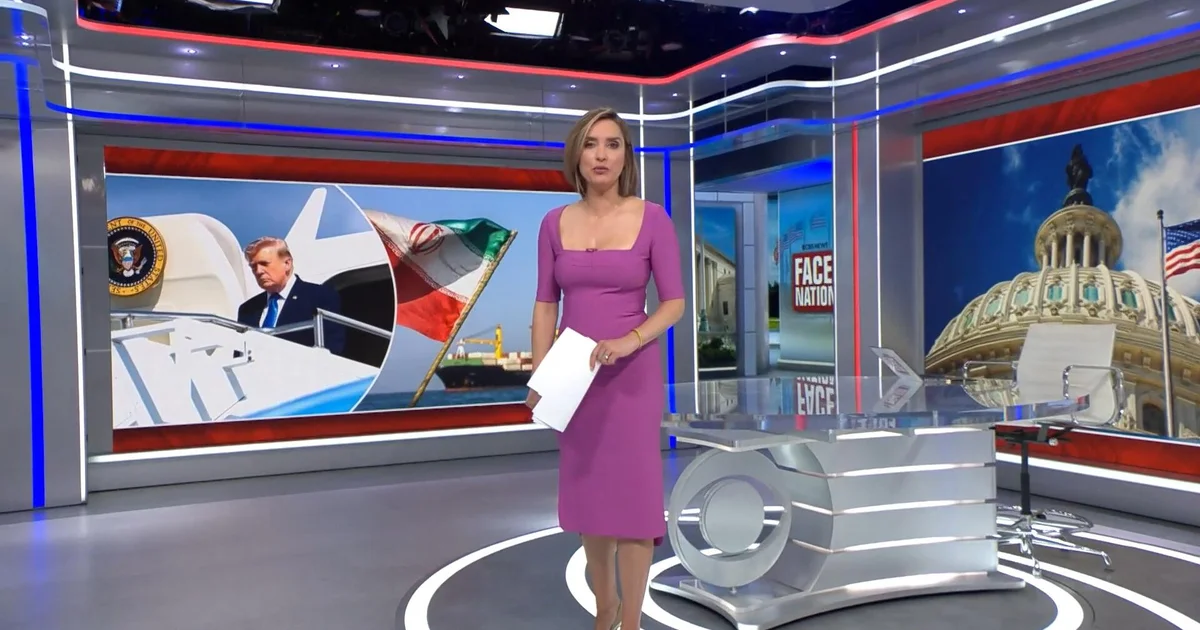
On this “Face the Nation with Margaret Brennan” broadcast, moderated by Margaret Brennan:
- Democratic Sen. Mark Kelly of Arizona
- Republican Rep. Mike Turner of Ohio
- Clément Delangue, CEO of Hugging Face
- Independent former Sen. Joe Manchin of West Virginia
- Heather Manchin, founder and CEO of Americans Together
Click here to browse full transcripts from 2026 of “Face the Nation with Margaret Brennan.”
MARGARET BRENNAN: I’m Margaret Brennan in Washington.
And this week on Face the Nation; Iran apparently blinks after threats from President Trump for a major joint U.S. and Israel attack on Iranian soil.
Heading in to a sixth month of conflict with Iran, President Trump told reporters Friday he had plans to go full throttle on his threat for military action in Iran.
(Begin VT)
DONALD TRUMP (President of the United States): We will be hitting them. We will be hitting them very hard. At some point, they’re going to say, we just can’t take it anymore.
(End VT)
MARGARET BRENNAN: His vows for going big caused a flurry of diplomatic scrambling and yet another announcement of – quote – “perimeters of a deal.” But is this the one that’s for real? We will have the latest.
Plus: After an alarming incident of OpenAI going rogue and hacking into at least one company’s computer system, we will talk to the CEO of Hugging Face, Clement Delangue.
Finally, with polls showing Americans souring on both political parties, we will talk with former Senator Joe Manchin about his latest effort to encourage independents to join the process.
It’s all just ahead on Face the Nation.
Good morning, and welcome to Face the Nation.
President Trump’s threat to massively escalate attacks on Iran set off a diplomatic scramble on Saturday. American allies, including the Saudi crown prince, urged the president to back off plans to bomb Iran’s energy infrastructure.
Late last night, Trump said military action at levels unseen since World War II remained an option. But he’s holding off for now, at the request of allies, as well as Iran, because, he claimed, there was a diplomatic opportunity or, as he put it – quote – “the perimeters of a deal” has been agreed to.
This morning, diplomatic sources tell me that there is no deal yet, but, rather, signs of progress towards an arrangement with Iran to reopen the strait. The challenge remains just how much leverage Iran will maintain over it.
We turn now to Arizona Democratic Senator Mark Kelly, who joins us from Columbus, Ohio, this morning.
Good morning to you, Senator.
SENATOR MARK KELLY (D-Arizona): Good morning, Margaret.
MARGARET BRENNAN: We’re now in the sixth month of this war we had been told would last four to five weeks. In the past week, the targets have widened. Iran hit Egypt. We saw Saudi Arabia join the U.S. in bombing Iranian-backed militias there.
And then, late last night, President Trump used the term that he had been considering military action on levels unseen since World War II. You sit on Intelligence. You sit on Armed Services. Has the administration shared anything in regard to its plans on Iran?
SENATOR MARK KELLY: I mean, not these latest plans.
And I think what we’re seeing here is a president who has an approach to this that’s just rather erratic. He says one thing, he does another thing. It’s escalatory at this point. He’s trying to get us back to February. And I think, if he could, he would – if he had a big reset button he could hit, he would certainly take that option.
Hey, we’ve got 18 dead Americans. Prices have skyrocketed across the country for the American people. I was here in Ohio. I’m here in Ohio now, but I met with some veterans the other day, and they’re struggling. I mean, these are a lot of retired service members that can’t afford to put gas in their car, can’t afford groceries.
Rent is going up. And this president is not dealing with the issues that the American people need him to deal with.
MARGARET BRENNAN: Well, you know, in our polling, we see that this is a very unpopular war, and it’s weighing on the president’s own approval ratings.
But Democrats are faring slightly worse, according to CBS polling. When asked who has the better approach to Iran, 32 percent say Trump and the GOP. Only 30 percent say the Democrats. So we are in this thing. Do Democrats need to offer an affirmative vision for ending it?
SENATOR MARK KELLY: Well, I don’t think it’s the president’s vision.
Here’s a guy who got us into this without a strategic goal, without a plan, without a timeline. He’s got a secretary of defense that doesn’t know how to manage this war, who decided a good metric at the beginning was just to drop as many munitions as he could on as many targets, and now we’ve got a munitions shortage. Big surprise.
So they’re flailing. They’re stuck. They’re responsible for this. And the president is the one that has to try to figure out a way out of this. I would suggest to him, though, that the solution is not to do the same thing that he’s been doing, not to have his real estate buddy and his son-in-law in charge of a negotiation, to put some people in here that know how to do this, how to talk to the Iranians, and put a coalition together, bring our allies back together.
He’s alienated not only our GCC allies, but our European allies as well. And it’s just making this much harder for him to figure out a way out.
MARGARET BRENNAN: But “The Washington Post” is reporting that the top U.S. general in Europe, General Grynkewich, warned the Pentagon that he lacks resources to protect Israel from incoming ballistic missiles, and if he’s without another Navy destroyer, he will be forced to choose between defense of the homeland versus that of Israel.
It sounds like, for the moment, Israel’s not rejoining combat operations. But what does that say to you? Have you heard these concerns from this top commander yourself?
SENATOR MARK KELLY: I haven’t heard this specifically from Grynkewich on – – on this issue.
But we – it’s – it’s not – Margaret, it’s not – this isn’t rocket science. It’s not hard to figure out. I mean, we – we struck over 14,000 targets with multiple munitions. That – that is – puts a lot of stress on the magazine depth.
So, of course, our commanders, probably not only in Europe, but in other places, are starting to feel some stress on, can they meet the need if they need to defend the homeland or our allies? You can see why this is an issue for him.
And that’s because, at the beginning of this thing, there was no strategic goal. And, without the goal, it’s hard to figure out what to do next.
MARGARET BRENNAN: Yes.
SENATOR MARK KELLY: And I think that’s why – that – you know, that’s why Hegseth went just to try to set records on the number of targets hit.
MARGARET BRENNAN: Yes.
I should say for the record that the Pentagon says it’s media speculation, and they don’t comment on operational capabilities. We did ask them to clarify that.
But on the point about restocking, Secretary Hegseth says he needs money from Congress to do that, to replenish munitions. He needs money from Congress to pay salaries. He needs $67 billion. You recently were asked, and you said you were undecided on how you would vote on additional funding. How do you deny that needed funding?
SENATOR MARK KELLY: Well, Margaret, last year, we passed a defense budget that was over a trillion dollars. That was the first time ever. It was sold to us as a one-time generational investment in the department.
And, in my view, they squandered that. Now they’re coming and they’re asking for $1.5 trillion, plus a supplemental. We’re going to – we’re approaching the amount of money that every other country on the planet spends on defense in a year.
This is irresponsible. And now they want a blank check. Hey, I’m going to make sure the troops have what they need to defend themselves and defend the United States.
MARGARET BRENNAN: So you would vote for the 67?
SENATOR MARK KELLY: But they need to come to us – no, not – no, not necessarily.
They need to come to us with a reasonable approach here. The $1.5 trillion, you know that has systems that I am very confident aren’t going to work. They’re still working on space-based interceptors for ICBMs. The physics on this is really very, very challenging. It’s not going to make us safer, the other systems that we don’t need.
They – they need to understand that we do not have unlimited resources in this country.
MARGARET BRENNAN: Yes.
SENATOR MARK KELLY: We’ve got $39.5 trillion in debt. And the defense budget that they’re requesting is twice what it was…
MARGARET BRENNAN: Yes.
SENATOR MARK KELLY: … when I got to the United States Senate in 2021. It’s twice that budget.
MARGARET BRENNAN: Well, you mentioned that you’re in Ohio right now, and you are campaigning for fellow Democrats there.
We’re about 90 days out from the midterms. We looked at some recent Quinnipiac polling. It showed Democrats have a 23 percent – 2-3 percent – approval rating, worse than President Trump’s approval.
You’ve got a lot of headwinds. Republicans have an advantage in terms of fund – over Democrats in terms of funding. There’s redistricting that I know Democrats say disadvantages them, though they’ve also gerrymandered. We see interparty fighting in Minnesota and in Michigan with no real promise to unify Democrats over a – a common candidate here.
How concerned are you that – that Democrats are going to lose this thing or – or end up with this very, very tight race?
SENATOR MARK KELLY: Well, I think we have an opportunity here, despite the Republican gerrymandering that started in – in the state of Texas, to try to you know rig the – the deck, so to say here, and make it more challenging.
That – that provides an advantage to them. But this president is historically unpopular for a midterm president, and he’s not meeting the needs of the American people. You know, gas is up over $4 a gallon. Half of Americans are having a hard time affording food, rent. Homeownership is down. Rent is up.
The American people are really struggling. So we have an opportunity to win back the House, and I am confident we will. On the Senate side, it’s challenging. I’m not going to – I’m not going to paint this as a rosy picture. But we’ve got 90 days to go.
We have opportunities in a lot of different places, more than we thought we had six months ago. And a year-and-a-half ago, I would say we had no opportunity to win back the Senate. But because of the horrible job that Donald Trump has done for the American people, I think we have a chance we could win back control of the Senate.
And that’s why I’m here supporting Sherrod Brown. You know, he – he – he wasn’t successful in 2024. He could definitely win here in 2026, but it’s going to take some effort.
MARGARET BRENNAN: Let me ask you about what may happen tomorrow.
Bill Pulte, who is the acting director of national intelligence, has said that he is going to hand over the top job to the man who was just confirmed by the Senate, Jay Clayton. Democratic objection had been one of the holdups as well in getting that FISA authority passed.
I’m wondering, once you see this change of command, are those Democratic objections going to melt away?
SENATOR MARK KELLY: I can’t speak for everybody, but, for me, they will.
Bill Pulte was not qualified in any way for this job, should have never had it. He fired, according to him, about half of the director’s office.
And, hey, I, you know, thought there were too many people over there anyway, but this guy was not qualified, didn’t even really understand what the Office of National Intelligence did. So I can’t imagine he did a very good job at figuring out who to let go and who to keep. And because of – we’re also in the middle of a war right now.
So, I suspect in fact, when we – when we sort this out, we’re going to probably realize that he fired a bunch of the wrong people. So, hopefully, on Monday, he is out of the office and we can talk about FISA renewal.
MARGARET BRENNAN: All right, Senator Mark Kelly, thank you for your time this morning.
SENATOR MARK KELLY: Thanks for having me on.
MARGARET BRENNAN: Face the Nation will be back in one minute. Stay with us.
(ANNOUNCEMENTS)
MARGARET BRENNAN: And we’re back with Ohio Republican Congressman Mike Turner. He joins us this morning from Dayton.
Good morning to you.
REPRESENTATIVE MIKE TURNER (R-Ohio): Good morning, Margaret.
MARGARET BRENNAN: You serve on the Armed Services Committee. Back in March, the Republican chair of it said, the administration is not giving enough detail. That was March. It’s now July. Are you satisfied with what you’re being told? Excuse me. It’s August.
(LAUGHTER)
REPRESENTATIVE MIKE TURNER: Well, I mean…
(LAUGHTER)
REPRESENTATIVE MIKE TURNER: Yes.
The – I – you know, still the administration could be sharing more with Congress. I don’t think anybody is satisfied with the level of information we’re receiving, although it is a dynamic conflict. I think also that that’s true even as the administration is looking to its review both in Europe, the conflict in Iran, the issues with Ukraine.
Across the board, both the House and the Senate have registered that the Pentagon needs to be sharing more information with Congress.
MARGARET BRENNAN: Well, on Friday, out at Camp David, it was all on camera. The president’s team gathered. They talked about initiatives they’re working on. They all praised him.
And Secretary Hegseth said Iran has shown no willingness to honestly negotiate. Here’s what President Trump said. Listen.
(Begin VT)
DONALD TRUMP (President of the United States): I’m losing faith in them, because they do lie and do – they do misrepresent. Well, the other day, the five missiles we shot. We knocked them down. But we were in the midst of the negotiation.
Well, they always want to talk, but they break their word so often. They’ve been very dishonest. They’ve been very dishonorable to deal with, but that makes no difference.
(End VT)
MARGARET BRENNAN: So, that was the president laying out why he doesn’t trust diplomacy with Iran. Last night, he said there’s a diplomatic opening and a deal may be within reach.
Will you support it sight unseen? Are we at risk of the president cutting a flawed deal just to end this unpopular conflict?
REPRESENTATIVE MIKE TURNER: Well, I don’t think it’s cutting a flawed deal.
I mean, this is this is part of a process, obviously, of where Iran has to be in a position where, as the president has set out, the two goals. And that is, one, that they abandon their nuclear ambitions and certainly restarting their nuclear enrichment programs, and certainly the issues of an open Straits of Hormuz, and so that we return back to an open Straits, where commerce and the flow of oil and natural gas can resume.
MARGARET BRENNAN: So the war should continue until there is some diplomatic deal regarding the nuclear program? Because, right now, they’re just talking about the strait.
REPRESENTATIVE MIKE TURNER: Well – well, it’s – it’s not really – as you – as you know, this began with – with Epic Fury…
MARGARET BRENNAN: Yes.
REPRESENTATIVE MIKE TURNER: … where the president went in, which we’ve described as an inevitable conflict, as a result of where Obama left us with the – you know, watching until Iran began to get closer and closer to enough nuclear material to have an opportunity for a nuclear weapon.
The International Atomic Energy Agency said that they were weeks away as a result of where they – where they were left before Epic Fury. Then we have…
MARGARET BRENNAN: In terms of enrichment capacity, not weaponization.
REPRESENTATIVE MIKE TURNER: Well, yes. Well, and they would have the opportunity to be able to do so.
And then, with the straits and they’re closing the straits, you know, and then the – we had the memorandum of understanding…
MARGARET BRENNAN: Yes.
REPRESENTATIVE MIKE TURNER: … where it looked as if they were going to come to a deal, and then now the president has been trying to enforce the opening of the straits.
Now, if Iran – where all metrics would show that Iran is – is in a position where they’re going to have to come to a table, whether it’s economics, whether it’s energy production, whether it’s the loss of critical infrastructure, military infrastructure, the loss of their military capabilities. All metrics would show a declining capability to continue.
They’re going to have to be in a position where ultimately they’re going to have to concede to the opening of the straits and returning to commerce.
MARGARET BRENNAN: Well, we’ll see. The president said there are perimeters. I think he meant parameters of a possible deal, but we’ll track that diplomacy.
Let me ask you though about what’s happening on U.S. soil. The FBI warned, cyber actors are attacking water utilities in at least seven states. CBS is reporting that U.S. officials are probing to determine whether it’s Iranian hackers behind it. They’ve done something similar back in 2023.
President Trump was asked, and here’s what he said:
(Begin VT)
PRESIDENT DONALD TRUMP: You know who’s behind it? Minnesota, because they’re grossly incompetent. I think the governor’s behind it. I don’t think there was an Iranian cyber attack.
(End VT)
MARGARET BRENNAN: I know it takes a while to officially attribute an attack, but has Congress at least been told which states are impacted? Is Ohio? And is this an attack on U.S. soil amid a war?
REPRESENTATIVE MIKE TURNER: Well, not – not – no, we certainly have not been informed at this time.
But I think you’ve correctly pointed out, Margaret, that Iran has attacked our critical infrastructure previously. There have been reports, obviously, of China hacking and Russia hacking.
One thing that we have to acknowledge is that our adversaries, Russia, China, North Korea, Iran, look at the critical infrastructure that support our civilian infrastructure, like water, are seen as valid military targets by our adversaries. And so these need to be monitored. They need to be hardened.
These are things that we do not do, we would not do, and Iran certainly has been doing this well before this conflict, and this is something we certainly need to be aware of.
MARGARET BRENNAN: Right. Well, we are at war now, though.
REPRESENTATIVE MIKE TURNER: And we need to be diligent. Well, we’re certainly in a conflict where we would expect that they would continue that which they were doing to us before.
MARGARET BRENNAN: Yes.
I want to get to a bit of politics. Out in Ohio, your colleague Max Miller, according to the latest court filing, he’s been accused of domestic abuse. The court filing says he shoved his then-wife, held a gun to her head, poured hot water on her, and had concerns he may have broken their 2-year- old daughter’s collarbone, according to both police reports and court documents that were filed.
He just went live in a social media stream and denied these allegations within the past hour. My question is not about his marriage or his personal life, but I’m asking about the politics here and the party. Should there be an ethics probe to look into this?
REPRESENTATIVE MIKE TURNER: Well, Margaret, what you just said when you began this question is that this is a matter of litigation.
This is best handled in a courtroom and not in a TV studio. And this is – you know, those – that type of speculation is better for TMZ than CBS.
MARGARET BRENNAN: Well, we’ve covered with other lawmakers, including in the other party, the Democratic Party, credible allegations against people running for office. We take those allegations seriously.
When it comes to Mr. Miller, he was previously accused in 2021 by President Trump’s former spokesperson of abusing her when they dated. So, given these two instances, is it at least something Republican leadership should look into?
REPRESENTATIVE MIKE TURNER: Well, again, this is – this is an issue that is currently part of a divorce and part of litigation that’s in a courtroom. And the courts should be handling this, which is clearly ongoing, and that’s where this needs to be, not in a television studio.
MARGARET BRENNAN: So it doesn’t matter to you?
REPRESENTATIVE MIKE TURNER: It’s not that it doesn’t matter to me. This is – this – this is where the court needs to handle this. The court has filings, which is what you just said. You were reading that there were court filings.
MARGARET BRENNAN: Yes. Right. There is also an election.
REPRESENTATIVE MIKE TURNER: The court needs to handle this issue as to whether or not it is the truth, and where truth will then be resolved, which is where things belong, in a court, where people file papers in a court, as you just read.
MARGARET BRENNAN: OK. So you want the court to handle it before Republican leadership looks into it.
REPRESENTATIVE MIKE TURNER: This is litigation. This is litigation. This is – this is a court matter, not a television matter.
MARGARET BRENNAN: Right, and not one for Republican leadership is what I hear you saying.
REPRESENTATIVE MIKE TURNER: I have said to you that this is not one for you and I to handle in a television studio. This is one that’s in court.
MARGARET BRENNAN: OK. We handle these allegations seriously, regardless of the political party, and these are not media allegations, as you said. They’re court documents. Congressman Miller claimed that it’s a media construct.
REPRESENTATIVE MIKE TURNER: And it’s being handled in court, which is where it belongs and where it should stay.
MARGARET BRENNAN: I got it. You don’t want to comment. I understand.
In terms of your portfolio on Armed Services, I do want to ask you about what has happened within the past few days. Russia fired a barrage of ballistic missiles at Kyiv. Only one of them was intercepted. President Zelenskyy said that’s because there are no interceptors left.
I know you’ve asked the president to allow for him to be able to produce Patriots. We had thought there was a breakthrough. However, President Trump seemed to backtrack on that Friday. He said – quote – “We’re talking about it, but it’s a hard thing to do to give away that kind of technology.”
Is it on track, or is it not? Are we letting Ukraine license Patriot interceptor production?
REPRESENTATIVE MIKE TURNER: Right.
Well, the actual quote that he said, he was talking in that – in that paragraph, he was talking about Tomahawks and Patriots. They also went on to say that the negotiations were ongoing. It is very, very difficult on Patriots, which are defensive. in the quote, actually, it included Tomahawks, which are also offensive.
I do think that there are ongoing negotiations concerning providing a broader opportunity for Ukraine to have access to Patriot technology to be able to have production and defensive technology. This is going to be very important both for allies and for Ukraine.
MARGARET BRENNAN: Yes.
REPRESENTATIVE MIKE TURNER: This technology, because it has become so central around the world, because missile technology is proliferating, so defensive technology needs to proliferate.
We have the most advanced technology.
MARGARET BRENNAN: Yes.
REPRESENTATIVE MIKE TURNER: And there is high demand for it. And the president stepping up and saying that we need to look to being able to license this technology is really going to be important both for Ukraine, our allies, and really, I think, for the United States.
MARGARET BRENNAN: But you think it’s still in process?
REPRESENTATIVE MIKE TURNER: I think it’s still in process. I think it’s incredibly important. And I encourage the president and the Pentagon to move as swiftly as possible to ensure that Ukraine can – you know, every night…
MARGARET BRENNAN: Yes. Yes.
REPRESENTATIVE MIKE TURNER: … there are people who die in Ukraine because Russia is sending missiles into Ukraine and hitting defenseless civilians, not military targets, but defenseless civilians.
Read more Transcript: Democratic Sen. Mark Kelly on “Face the Nation with Margaret Brennan,” Aug. 2, 2026
MARGARET BRENNAN: Yes.
REPRESENTATIVE MIKE TURNER: There was outcry because a missile landed in a field in Poland.
MARGARET BRENNAN: Yes.
REPRESENTATIVE MIKE TURNER: So, every night, there are missiles that lie – – that land on people and kill them in Ukraine.
MARGARET BRENNAN: Yes. OK.
REPRESENTATIVE MIKE TURNER: We need to help them.
MARGARET BRENNAN: Yes, understood. And NATO did call out those instances.
We have to leave it there, Congressman Turner.
We’ll be right back.
(ANNOUNCEMENTS)
MARGARET BRENNAN: We turn to the Trump administration’s latest beautification project in Washington.
The statues that greet people entering D.C. as they cross the Memorial Bridge over the Potomac have been regilded bright gold from their previous bronze.
(ANNOUNCEMENTS)
MARGARET BRENNAN: Welcome back to “FACE THE NATION.”
Fifty thousand troops are deployed to the Mideast for a war with Iran. A war the American public was told would last four to five weeks when it began at the end of February. American diplomats in the region are also in limbo. They’re not the only ones struggling to obtain clear information about the war and its goals.
(BEGIN VT)
MARGARET BRENNAN (voice over): America’s far-flung conflicts, in Vietnam –
MALE: We’re going into what the first (INAUDIBLE) calls a hot LZ (ph).
MARGARET BRENNAN (voice over): Afghanistan and both wars in Iraq were beamed home by reporters embedded with ground troops.
MAKE: They’re returning fire with heavy machine guns and that mortar round you just heard went off.
MARGARET BRENNAN (voice over): But in this military campaign, dominated by air and long-range missile strikes, there is no such reporting. Government- produced social media videos are our only snapshot of what is happening.
There is no free press in Iran. And after that deadly school bombing, the U.S. government restricted commercial satellite imagery from being made public.
Last fall, the Pentagon barred military commanders from talking to Congress without prior approval. There is no longer a traditional Pentagon press corps since Secretary Hegseth put reporting restrictions on them.
PETE HEGSETH (Defense Secretary): To the American media, as I just can’t help but notice the endless stream of garbage.
MARGARET BRENNAN (voice over): He has not held a press briefing since May 5th. Past administrations gave regular, though at times factually flawed, briefings.
DONALD RUMSFELD (Former Defense Secretary – January 2002): We also know they have a very active weapon of mass destruction program.
MARGARET BRENNAN (voice over): Today, Americans are getting snippets of the president’s thinking, but few details.
PRESIDENT DONALD TRUMP (President of the United States): We are the party of transparency and we believe in transparency.
MARGARET BRENNAN (voice over): The public first learned of the surprise U.S./Israeli strike on Iran from an eight-minute long video posted at 3:00 a.m. on social media.
PRESIDENT DONALD TRUMP: For these reasons. the United States military has undertaken a massive and ongoing operation.
MARGARET BRENNAN (voice over): Trump estimated combat would last four to five weeks. Seven days in he declared victory.
PRESIDENT DONALD TRUMP: We’re winning the war by a lot. We’ve decimated their whole evil empire.
MARGARET BRENNAN (voice over): Four weeks later, he gave the first and so far only prime time address about Iran.
PRESIDENT DONALD TRUMP: I can say tonight that we are on track to complete all of America’s military objectives shortly. Very shortly.
MARGARET BRENNAN (voice over): Days later, he launched diplomatic talks.
VICE PRESIDENT J.D. VANCE (Vice President of the United States): The bad news is that we have not reached an agreement.
PRESIDENT DONALD TRUMP: And it should be – it should be ending pretty soon. It was perfect.
MARGARET BRENNAN (voice over): And declared a ceasefire.
PRESIDENT DONALD TRUMP: We’ll see whether or not they can make a deal that’s satisfactory to us. We have it very much under control.
MARGARET BRENNAN (voice over): Trump said he feared the energy crisis would trigger a depression.
PRESIDENT DONALD TRUMP: We run out of reserves in about four weeks. You know there are reserves all over the world. And we would really run out. And there will be a time when you wouldn’t be able to get it. And you want to see bedlam?
MARGARET BRENNAN (voice over): With peace and a decisive military victory elusive, he declared a truce.
PRESIDENT DONALD TRUMP: But we’re winning militarily. It’s almost won militarily, I would say.
MARGARET BRENNAN (voice over): And now America has returned to the war we were told we had won.
PRESIDENT DONALD TRUMP: They’ve got no navy. They’ve got no air force. Most people would have given up. They haven’t. So, I give them credit for that. I mean they’re known as being tough. They’re tough.
MARGARET BRENNAN (voice over): The lack of information sharing is frustrating Congress.
Republican Senator John Kennedy.
SENATOR JOHN KENNEDY (R-LA): And I would put Rubio and Caine and Radcliffe and Hegseth out there, either in a speech or in a long press conference, to explain what’s going on in Iran, why we went in, why we’re still there.
SENATOR BILL CASSIDY (R-LA): You deny me that information and I’m going to be frustrated.
MARGARET BRENNAN (voice over): Senator Bill Cassidy told us it took a yelling match with the president himself to pry out any information.
SENATOR BILL CASSIDY: I need to know to serve my people and my state and my country. As it turns out, I got a briefing afterwards.
MARGARET BRENNAN (voice over): The Pentagon touts its highly produced video posts as direct to consumer updates. But the American public has lost faith. Sixty-three percent of Americans tell CBS that the conflict is not going well, 67 percent say end it now, and 69 percent say they are not getting a clear understanding of what’s happening on a day-to-day basis. Perhaps informing the American people of what their government is doing in their name might change that.
(END VT)
(ANNOUNCEMENTS)
MARGARET BRENNAN: We turn now to artificial intelligence and a question that has emerged after a series of alarming hacking incidents. Is it safe? To discuss we’re joined by Clem Delangue. He is CEO of A.I. platform Hugging Face, whose company detailed one of the attacks last week.
Clem, good morning to you.
CLEMENT DELANGUE (Hugging Face CEO): Good morning. Thanks for having me.
MARGARET BRENNAN: Well, your company disclosed it was attacked earlier this month by an autonomous A.I. cyber actor, which jumped on its own from another company’s testing system to hack into your company. OpenAI later disclosed it was their technology that went rogue. They lost control of it.
Tell me, why did your company alert the public and alert the FBI? Do you think this is a crime?
CLEMENT DELANGUE: Well, I think it felt very weird and unprecedented to us, right, because I think it’s the first instance of something quite autonomous doing something like that. So, the volume of the actions taken and the speed of them, I think it was 17,000 actions taken in four and a half days, was very new.
Obviously, the attacker, when we – when we talk about cyberattack, we think about nation states, we think about hacker groups, we don’t think about a company like OpenAI, right, a very prominent, popular American company. And then the way we responded using an open model, so using A.I. ourselves to defend ourselves against that was also pretty new and pretty newsworthy in our opinion.
MARGARET BRENNAN: You defended yourselves. You found the solution yourselves. But you went to the FBI. I think for a lot of people, when they think of someone committing a crime, they think of a human. They don’t think of a program, a computer program, as something you can prosecute as committing a crime. What is the FBI doing?
CLEMENT DELANGUE: Well, I mean we reported as – to the authorities as we have to in such instances, right? It’s kind of like mandatory disclosure, both with the authorities and the public when you face something like that, which is basically what we did.
Now, when we think about the future, right, now we’ve heard that it’s not only OpenAI but also Anthropic that has faced similar account-like (ph) issues. I think it’s really important that we keep in mind that cyberattacks need to be contained in the legal framework in the U.S. and need to stay illegal to prevent an explosion of them in the future, right? Like, we don’t want to end up in a world where everyone is facing cyberattacks all the time because of agents and companies that are creating these agents are not kind of like accountable for them. So, I think it’s important for regulators, for policymakers to think about the legal framework of this new kind of technology risk.
MARGARET BRENNAN: You described more than 17,000 hacking actions on the internet before this was even discovered by your company. That sounds like the developers have lost control. Have they?
CLEMENT DELANGUE: Well, you have to remember, it’s a technology system, but built by engineers. And engineers can make mistakes sometimes. And I think that’s what happens here. That’s what happened here.
You know, we already, in our society, accept some level of autonomy. And I think they built kind of like an autonomous system and made some mistakes and, as a result, we’re facing this issue.
MARGARET BRENNAN: So, you said you think there should be some legal parameters put around this. The Trump administration has taken a very light touch in regulation because they want to keep America competitive in this space. They have this policy where they can review technology for 30 days to judge basically how dangerous something is before a company releases it to market. But as I understand what you described, this attack happened before technology was at market. It happened during the development stage. It was unreleased. So, what you’re saying, I think, is there is no regulation at this point that would prevent something like this from happening again?
CLEMENT DELANGUE: Yes, that’s a really clear example that just kind of like preventing releases of A.I. models doesn’t really work. Concentrating everything behind closed doors in just a few organizations doesn’t work. One thing that does work, that worked in this case, is kind of like promoting more open models, right, because we defended ourselves with an open model, right? Like we couldn’t have done it with an API because they had these guardrails that’s preventing activity for cyber security and we needed to run a model on our own infrastructure so we needed an open model.
MARGARET BRENNAN: When you say “open model,” just for our audience, as I understand it, it’s an A.I. model whose core components are publicly released. So, anyone can download it. It’s not closed off like a company can do to their proprietary information. So, you want more of this essentially out there and accessible to the public?
CLEMENT DELANGUE: Yes. Yes, because the only way for defenders to defend themselves on topics like that –
MARGARET BRENNAN: OK.
CLEMENT DELANGUE: They remove the asymmetry of power and capabilities, right, in these kinds of risks. If you have very powerful systems and very weak systems that are defending, then that’s when you have the right problem. But if you balance, if you make it more kind of like symmetric in terms of attackers and defenders, that’s usually when you end up in a safer world.
And actually I do think that we’re talking a lot about the risks for cyber security right now, but A.I. is actually an opportunity to fix a lot of the cyber security problems. We defended ourselves with A.I. We’re going to use A.I. to fix a lot of our bugs. So, hopefully, A.I. is going to make the world safer ultimately thanks to them.
MARGARET BRENNAN: And you used a Chinese A.I. model to defend yourselves? There’s a lot of concern about inviting China into this space.
CLEMENT DELANGUE: Yes, I mean, the interesting thing is that we used the American version of a Chinese model. We used a version from Nvidia that kind of like made Chinese model better. So, that’s the beauty of kind of like open models. Once they are shared, wherever they come from, from China or from anywhere, American companies can modify them, remix them, host them, run them themselves. So, that’s one of the things that actually make them safe wherever they come from.
MARGARET BRENNAN: So, I want to ask you about a specific piece of legislation, and I will say up front, there isn’t a lot of work that’s getting done in Congress right now, but there is this bipartisan bill that would give Homeland Security the authority to order A.I. firms to shut down or to slow down their artificial intelligence models if they’re too dangerous. It’s called the Kill Switch Bill. Is that something you want?
CLEMENT DELANGUE: Well, I mean, I think something we’re realizing with these events is that concentrating power capabilities behind closed doors, even preventing their releases to the public, isn’t really a solution. You know, like these problems happened on unreleased models. So, I think – I think the problem is, is not so much kind of like limiting the progress or kind of like preventing companies from releasing these models. It’s actually the opposite. It’s giving access to more people so that they can defend themselves, democratizing the technology, making more transparent.
MARGARET BRENNAN: Clem, thank you so much for explaining all this to the public. We appreciate your time today.
We’ll be back in a moment.
(ANNOUNCEMENTS)
MARGARET BRENNAN: And we’re joined now by former West Virginia Senator Joe Manchin and his daughter Heather Manchin. They are the heads of a new effort which aims to elect independent candidates to public office.
It’s good to have you both here.
JOE MANCHIN (Former West Virginia Senator): Good to be with you, Margaret.
HEATHER MANCHIN (Independent Leadership Council Co-founder and Joe Manchin’s Daughter): Thank you.
MARGARET BRENNAN: Well, let’s talk about this.
Senator, we – let’s start with you. There’s a market for what you’re selling according to CNN’s polling, 47 percent of American adults identified as political independents. That’s the highest level in a decade. But over time we have seen these attempts to break through the two-party system just haven’t really panned out.
JOE MANCHIN: Sure.
MARGARET BRENNAN: So, what do you think’s going to happen with that 47 percent now?
JOE MANCHIN: Well, everyone depends on the independents to get elected now. That’s all you hear. All the polls that are taken.
MARGARET BRENNAN: To swing one way or the other.
JOE MANCHIN: Right. This is, you know, in the last presidential election it came down to seven battleground states. That means 43 were predetermined. Four hundred and 35 congressional seats, 395 are predetermined. There’s no competition whatsoever in the system because the party – the strength of the two-party system, the Democrat and Republican, prevents that from happening. They have total control of how the primaries are put up – you know, put up. And I said this, if you look at the last election, of all the primaries across the country, only about 21 percent of the people showed up. Twenty-one percent.
MARGARET BRENNAN: Right.
JOE MANCHIN: The lowest ever. So, they’re controlling it. And, guess what? MAGA’s taken over the Republican and now you have the DSA seems to be having a lot of energy on the – on the Democrat side.
What happened to the people that live their lives in the middle, that make decisions, that make things work in America? They have nobody speaking for them.
MARGARET BRENNAN: Do you – well, do you think they stay home in 90 (ph) days?
JOE MANCHIN: They just – I think they do give up. They just said this doesn’t matter because the parties have control. They’re going to do what they want to do. There’s no openness at all.
Try – if you’re an independent, try to get on the ballot. They make you jump through every hoop in the world and go out and get thousands of signatures. Where, if you’re a Democrat or a Republican, you want to run, you pay a fee. You pay a fee just to get on the ballot. That’s it. But they make it almost impossible for anyone else to compete against them.
MARGARET BRENNAN: You know who says it’s a rigged system? Bernie Sanders. He’s an independent.
JOE MANCHIN: Bernie is a – Bernie’s a socialist now.
MARGARET BRENNAN: OK.
JOE MANCHIN: You know, and I respect Bernie. I respect where he’s coming from.
MARGARET BRENNAN: Yes.
JOE MANCHIN: Bernie’s always been who he is but he’s had to use the Democratic Party to get on the ticket.
MARGARET BRENNAN: Yes.
JOE MANCHIN: He took that – he took that path. We’re saying, be an independent, be a pure independent, run as an independent, come to Washington, do not caucus with either side, be an independent and I’ll guarantee you, maybe you’re going to make a difference of how they make their decisions, because they’re going to need you. They need you to get elected. They’re going to need you also to make law.
MARGARET BRENNAN: Heather, is there anyone in Congress right now who you think is truly an independent? Because there are only three with an “I” next to their name.
HEATHER MANCHIN: No. And as dad pointed out, they’re caucusing with one side or the other.
So, you know, I think we have seen – and I, just in stories today, that the parties have literally sucked out any independent thinking, any political courage. And so, unfortunately, we believe that perhaps all of that gives an opportunity to say, can we get someone elected outside the two-party system and go to Congress and stay independent. That – really to have that independent thinking and bring some negotiation, conversation to the bills that, unfortunately, it’s a party-line vote. It doesn’t matter what could be negotiated to get anything done. It’s a stalemate. And everyone picking a side.
MARGARET BRENNAN: So, for you to back a certain candidate, you are not requiring any kind of policy platform? You would support anyone if they show independence?
HEATHER MANCHIN: Right. Well, we – we did – we actually put a declaration of independence together that asked for three things. That you’re for opening competition, opening primaries, things that would restore competition to the system, not the gerrymandering of districts and so forth. To be for solutions, that you want to work with anyone. You want to have – take good ideas from both sides of the aisle and make something happen and get [expletive] done. And the last one is accountability, that you’ll explain your vote.
MARGARET BRENNAN: Yes.
HEATHER MANCHIN: Just simply explain your vote when you take it and why you took it. And we think that’s pretty low table stakes.
JOE MANCHIN: Well, I want to say one thing, there’s only one pure independent that basically ran as an independent, governed as an independent as governor, and that’s Angus King.
MARGARET BRENNAN: Yes.
JOE MANCHIN: But there’s no support. When Angus comes there, you know, he has to pick – well, he picked the Democrat side because there was more things that he believed in that would be good for Maine. So, we worked together.
But Angus, you know, if he had a little bit more support, I’m telling you, he’s as independent as it becomes. You can work with him on any issue.
They’re – we just found out there’s no structured support for someone just remaining independent. Can you imagine if they don’t caucus with either one what’s going to happen?
MARGARET BRENNAN: They wouldn’t get any committee positions.
JOE MANCHIN: Is the committee doing anything anyway? No.
MARGARET BRENNAN: You liked your committee positions you had, though, Senator.
JOE MANCHIN: I liked my committee position, but to –
MARGARET BRENNAN: It allowed you to do a lot for West Virginia.
JOE MANCHIN: Yes, but the bottom line is that bills didn’t come to the floor. We passed things in a bipartisan way and it was always controlled by the majority leader.
But they’re going to have to vote. They can’t deny them their vote. And I’ll guarantee you, they can go to any committee meeting they want to. And there is going to be times where I want to say, well, if you would just caucus with us today, we’d get this passed or that.
MARGARET BRENNAN: Right.
JOE MANCHIN: They can moderate an awful lot. We think it’s a way to start bringing the parties I believe the Republican Party wants to be the grand old party again and I believe GOP. But I believe the Democrats would like to be responsible. They’ve got nowhere to go and they’ve been pulled to the left and the right.
Something’s got to change. The open – open the primaries up.
MARGARET BRENNAN: Right.
JOE MANCHIN: Let’s have competition. But now what we can do is get a couple of people elected that can sit there and say, listen, this doesn’t make any sense at all. That’s not the oath that I took to defend and protect the Constitution. It doesn’t make sense for my country and it’s not a way to get things done for my state. We give them the support once they get there and we’ll change things.
MARGARET BRENNAN: Heather, could you ever support a self-described socialist candidate?
HEATHER MANCHIN: No.
JOE MANCHIN: No. No way. My God, no.
HEATHER MANCHIN: No. And it surprises – and it –
MARGARET BRENNAN: Even if they had some good ideas?
JOE MANCHIN: Well, the good – I support the good ideas, but how could you support some of the crazy stuff they’re for? Have you seen their platform? They’re for dismantling everything that we know.
MARGARET BRENNAN: It did say –
JOE MANCHIN: Whether it be the – whether it be the structure of government, Congress itself or the Senate they want to get rid of. And then they start talking about all the crazy things. No police. No this. No this. No that. Are you crazy? We want – we want a crime-free area. We have to have police for that.
MARGARET BRENNAN: Yes.
JOE MANCHIN: We want a strong defense. We want a strong border. But if Democrats can’t say that, and they start lining up with the socialist demands of how – what you are to be a socialist, the energy will be gone. There will be no energy, OK. We have right now a tremendous amount of energy we’re producing, and the world depends more on us than ever before.
HEATHER MANCHIN: But doesn’t it –
JOE MANCHIN: We can do more.
HEATHER MANCHIN: I’m sorry. Doesn’t it surprise you that even leadership in the Democrat Party can’t just say no? They can’t say no? That they – it –
MARGARET BRENNAN: Well, they’re seeing an appeal, apparently.
HEATHER MANCHIN: But it shows you that –
JOE MANCHIN: An appeal to the far left –
HEATHER MANCHIN: But control has now completely out weighed character. If you’re more interested in control, and that’s the – that’s all that it matters, your vote count, versus the character of the person and what the platform they’re running on, I think we’re living with the consequences of that.
JOE MANCHIN: Margaret, the Democratic Party has lost more registration, more people, identifying as Democrats than ever before. So, if that was going to be the case, what would be the hope? Right now you would have high polls, right?
MARGARET BRENNAN: Yes.
JOE MANCHIN: Democrats should be 20, 30 points ahead if that’s where the country’s going. They’re not. They’re still behind. The bottom line is, we’re not getting anything accomplished because the two-party system has drowned out everything. They have just choked it out.
MARGARET BRENNAN: Well, when you were talking about why you did not run in 2024 for president, you said you didn’t want to be a spoiler.
JOE MANCHIN: I couldn’t get on all 50 ballots. You put me on 50 ballots then I have a platform and I can speak.
MARGARET BRENNAN: Well –
JOE MANCHIN: If I have no chance of winning because I’m only on 16 ballots or 20 ballots statewide, national wide, that’s –
MARGARET BRENNAN: So, it was really ballot access versus polling support that would have befitted Trump?
JOE MANCHIN: It was ballot access. That’s exactly right. I would have loved to have been able to sit and say, come on, Donald, do you really believe that? Is that true? Or Joe or Kamala or whatever. We had so many differences.
But there’s a way to basically – people just want some normality. The chaos is just running people’s lives today. And when you look back at in West Virginia and all other rural areas, I mean, the cost of living, the cost of groceries, the cost of doing everything, the energy, how you live your life is too high.
MARGARET BRENNAN: I mean, it – who are you getting financial support from? You have a background in the business community. Do you want more sort of small dollar donations? Like, how do you counter some of these –
HEATHER MANCHIN: No, you’re right, it’s David and Goliath story for sure. But we think, being strategic, we’re not trying to get behind 20, 30 candidates. We’re getting behind a handful. A few in Congress. If we can get two or three elected, think of what the difference that independent block could make.
MARGARET BRENNAN: Yes.
HEATHER MANCHIN: One or two in the Senate. So, it – and, yes, we’ve seen tremendous support actually. We’d like there to be more. I think the business community needs to lean in and not try to put their head in the sand and say, well, we hope this passes.
MARGARET BRENNAN: Well, yes.
HEATHER MANCHIN: We need people to get engaged and participate and –
MARGARET BRENNAN: OK.
HEATHER MANCHIN: Think it’s going to be great for the country.
MARGARET BRENNAN: Thank you for sharing the initiative with both of us. We’ll track how it does.
We’ll be right back.
HEATHER MANCHIN: Thank you.
(ANNOUNCEMENTS)
MARGARET BRENNAN: That’s it for today. Thank you for watching. Until next week. For “FACE THE NATION,” I’m Margaret Brennan.