
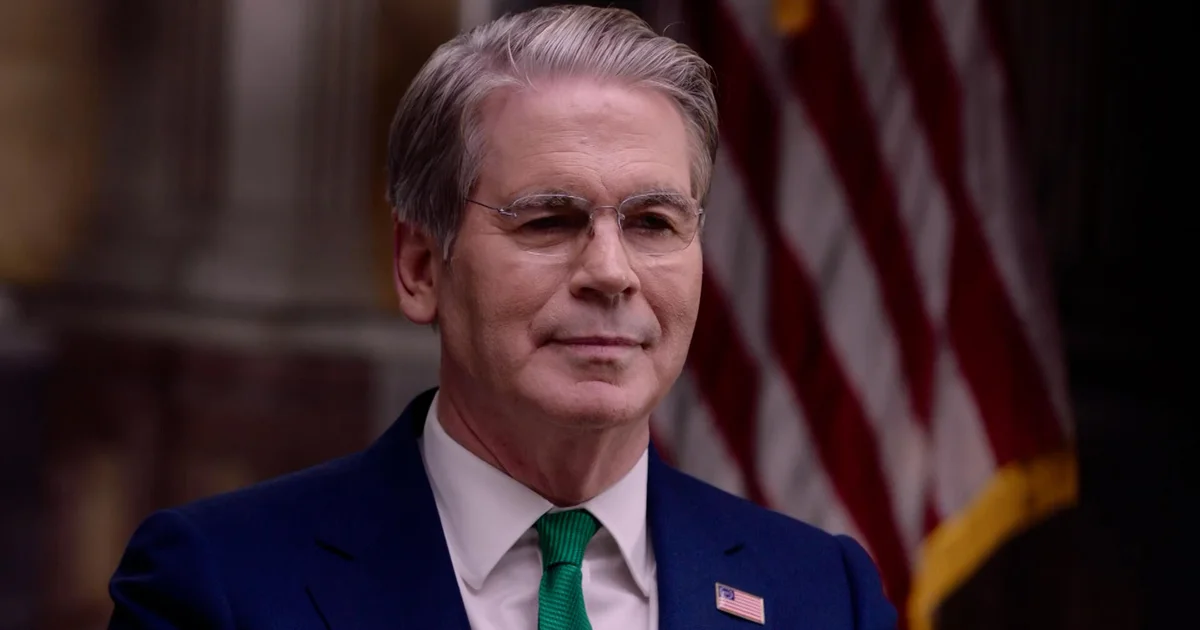
In an exclusive interview with CBS News on Thursday, Treasury Secretary Scott Bessent said he doesn’t believe the recent disclosure of President Trump’s billions in crypto earnings is problematic for the president.
Read more Former CDC official says RFK Jr.’s response to measles outbreak “not based on science or reality”
“I don’t think there’s an appearance problem,” Bessent told CBS News anchor and MoneyWatch correspondent Kelly O’Grady regarding Mr. Trump’s earnings.
According to a financial disclosure released earlier this week, Mr. Trump has earned approximately $1.4 billion from his crypto ventures since beginning his second term. Those include his “meme coin” $TRUMP and earnings from World Liberty Financial, a cryptocurrency company backed by the president and his family.
Congressional Democrats have criticized Mr. Trump’s crypto windfall, arguing it presents a conflict of interest since his administration has sought to loosen regulations on cryptocurrency.
“This is an innovation presidency,” Bessent told CBS News. “So whether it’s digital access, whether it’s AI, whether it’s everything that is going on in the tech ecosystem that, you know, all Americans are benefiting from that.”
White House spokesperson Anna Kelly told CBS News on Tuesday that “there are no conflicts of interest” in the disclosure.
In his interview with CBS News, Bessent also touched on the latest developments with the tax-deferred Trump Accounts and his outlook for the U.S. economy as it grapples with the impacts of the Iran war.
Economic relief is coming for American families, Bessent believes
The Treasury secretary said his message to Americans who are experiencing strain at the grocery store and at the pump wrought by the Iran war is that “we’re going to get to the other side of this.”
Since the war began in late February, halts to shipping traffic in the critical Strait of Hormuz, which handles roughly 20% of the world’s global oil supply, have led to rising gas prices, which have in turn accelerated inflation and raised costs more broadly. In May, the annual inflation rate rose to 4.2%, according to the Labor Department, its highest level since April 2023.
The average price of a gallon of regular gasoline on Thursday was $3.83, according to AAA. At the height of the war, gas prices topped $4.50 a gallon, but have steadily declined in recent weeks as oil prices return to near prewar levels and the U.S. and Iran negotiate over a more permanent end to the war.
Bessent said he is hopeful that the average drops to $3 a gallon by Labor Day.
“Gasoline prices are a little stickier on the way down,” Bessent said. “We’re trying to give the gasoline retailers a little bit of a nudge. We’re telling them we’re watching them. We’ve had some good uptake from some of the bigger retailers from some of the bigger retailers in terms of what they want to do for consumers.”
Thursday’s jobs report from the Bureau of Labor Statistics showed that U.S. employers added 57,000 jobs in June, far below what economists had predicted, but the unemployment rate held steady, dipping slightly to 4.2% from 4.3% the month before. However, the report found that annual wage growth was 3.5%, below the rate of inflation.
Bessent described the discrepancy between wage gains and inflation as a “short-term spike,” and said he expects to see oil and energy prices continue to drop.
“I would expect, perhaps, as soon as this month, we’re going to see real wage gains,” Bessent said.
Asked whether the stock market’s strong performance in recent months, or the real-world pressure facing many Americans, is a more realistic view of the state of the U.S. economy, Bessent said he believes the market’s strong performance will be predictive of the direction the economy takes.
“The stock market lives in the future. So what the stock market is telling us is, presumably, what I am saying today, that we’ll get to the other side of this,” Bessent said. “Rates will come down and then we will be back up to real wage gain. So both can be true.”
Trump Accounts a tool to create “financial literacy,” Bessent says
The White House announced this week that beginning on July 4, Americans can begin contributing to Trump Accounts, a federal program launched earlier this year designed to help children under 18 invest money in the stock market and build savings before they reach adulthood, similar to how adults save for retirement.
“Thirty-eight percent of American households have no investment in our great equity markets, and we want everyone to share, you know, in the bounty that is the U.S.,” Bessent said. “In our innovation and our capital markets, and, you know, the economic engine, greatest in the history of the world. So, you know, over time, I would think that that 38% number would move toward zero. And then the other thing too is financial literacy.”
According to Bessent, more than 6 million Trump Accounts have been opened so far, and there are approximately 70 million children in the U.S. eligible for them.
On July 4, the federal government will begin contributing $1,000 to accounts for eligible children who are born between Jan. 1, 2025, and Dec. 31, 2028. The Trump Accounts were part of the White House’s “big, beautiful bill” legislation passed last year.
Bessent noted how wealthy philanthropists, organizations and states can also donate to the accounts, even by contributing public stock. Last year, Michael Dell, who founded Dell Technologies, and his wife Susan Dell announced they would donate $6.25 billion to the accounts, or $250 per person.
“I would expect that we are going to see, again from these philanthropic families and institutions and companies, I would expect that we would see the lower-income profile families, actually the accounts will be topped up more,” Bessent said.
Bessent said the accounts could also build throughout adulthood and be rolled into an individual retirement account.
“We want them to really understand the power of long-term compounding,” Bessent said of the families who take part in the program. “That you’ll own a share of a company, that many people have – bank deposits. They’re used to getting interest, they’re used to paying interest. So what we want them to understand is, what does a piece of the action feel like?”
Read more Kennedy Center selling $25,000 ticket package to watch D.C. July 4th fireworks