
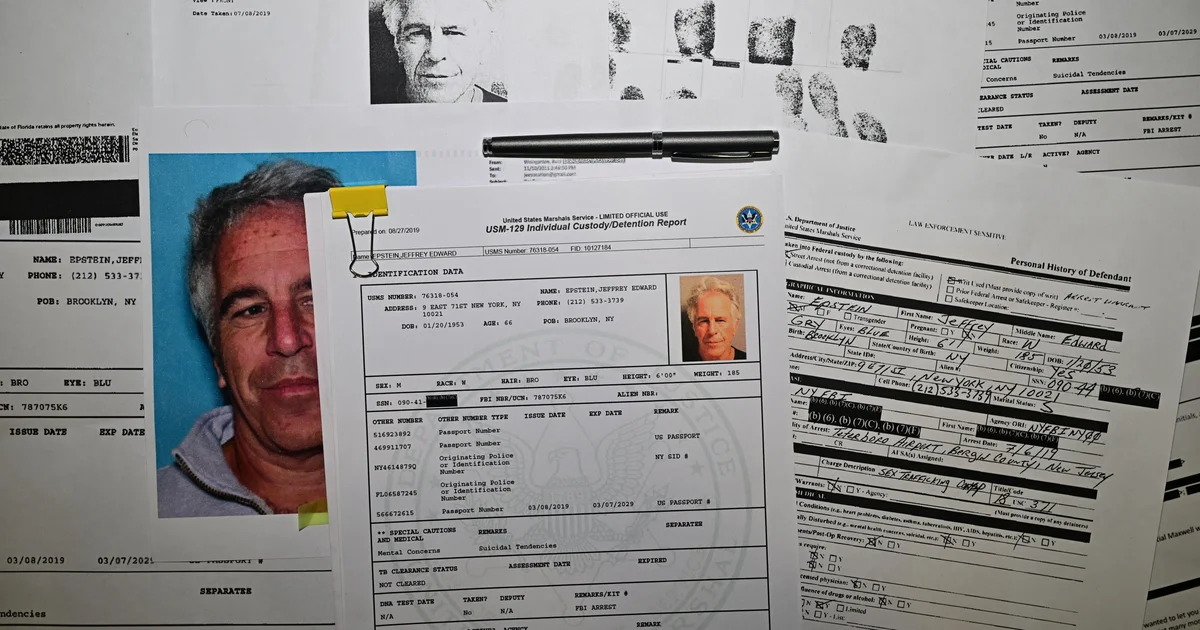
When the Department of Justice released more than 3 million pages of documents under the Epstein Files Transparency Act, survivors, advocates and lawmakers quickly raised questions about an apparent discrepancy: the DOJ had said it collected more than 6 million pages of material during its investigation but was only releasing half that number.
Read more Rips appear in Reflecting Pool’s new sealant, chosen by Trump, after algae turn water green
The Justice Department tells CBS News it “has released every document required by the Epstein Files Transparency Act,” and maintains that those unreleased 3 million documents were either duplicative, unrelated to Epstein or protected by legal privilege.
But concerns persist about evidence that important documents are still being withheld. At the same time, the Government Accountability Office recently announced it was launching an investigation into the way documents that were released had information blacked out. That move comes at the of several members of Congress.
Rep. Robert Garcia, the top Democrat on the House Oversight Committee, says that if there are duplicates, “OK, that’s fine, let’s see them.” He adds, “I think what people need to understand is … we’re not sure what’s in the 3 million.”
CBS News has analyzed the archive not only for what has been disclosed, but also for documents that appear to be absent. Despite the unprecedented volume of material now available, it’s apparent that many gaps remain in the public record surrounding Epstein’s activities, his communication, the federal investigations into him and the circumstances surrounding his death behind bars.
Our review identified several areas where important questions remain unanswered or documents appear to remain unreleased.
Redaction issues
The Epstein Files Transparency Act provides only limited grounds for withholding information or redacting names. Its primary purpose is to protect victims. specifically excluded “reputational harm, or political sensitivity” as a reason for redacting. Yet in many instances prominent individuals’ names were redacted while victims’ names were not.
Some redactions seem difficult to justify. In one example, a text where Epstein sent Steve Bannon a link to an article, Bannon’s face was blacked out in a photo that had already been publicly posted online.
Elsewhere, the names of business contacts and acquaintances of Epstein appear to have been redacted without an obvious reason under the terms of the law.
In another widely cited example, a with the signoff “Love, Melania” had the full name and email of the sender and receiver redacted. In April, first lady Melania Trump acknowledged having exchanged emails with Ghislaine Maxwell, saying in a statement that it “cannot be categorized as anything more than casual correspondence. My polite reply to her email doesn’t amount to anything more than a trivial note.”
The Epstein Files Transparency Act requires the DOJ to provide a justification for every redaction. It permits withholding information that “would constitute a clearly unwarranted invasion of personal privacy,” but also states that all redactions must be accompanied by a written justification published in the Federal Register and submitted to Congress. The Department of Justice has made no attempt to address specific redactions and instead issued a general statement saying its redactions were “[c]onsistent with the Act.”
Members of Congress have been given the opportunity to review redacted material, but the process is time consuming and some have complained their searches are being monitored by the DOJ.
After CBS News reached out to the DOJ for comment on these redactions, the photo of Bannon and two of the emails were quietly un-redacted. After one of those was un-redacted, it revealed the sender was former U.K. diplomat Peter Mandelson, who was arrested earlier this year on suspicion of mishandling sensitive government documents, which BBC News reports he denies. Mandelson has said he regrets his friendship with Epstein and says he never witnessed criminal activity.
A gap in email communications
The DOJ released millions of Epstein’s emails. Nearly all originate from an email account he created around the time he went to jail in 2008: [email protected].
Missing from the Epstein files are emails from his other, earlier accounts, including approximately 20,000 messages from Epstein’s [email protected] account, which were previously obtained by hackers and later archived by the nonprofit Distributed Denial of Secrets. It’s unclear if the DOJ itself ever obtained those emails.
Some older email messages do appear in records apparently obtained from Ghislaine Maxwell’s accounts or other sources, but the DOJ’s release is missing most of Epstein’s earliest communications.
However, a batch of documents raises questions about what the DOJ does have; a series of screengrab images of Epstein’s inbox for an email account [email protected] (a reference to his island, Little St. James) from the early 2000s — notably a period of time when Epstein was in touch with Donald Trump, whom he knew through New York and Palm Beach social circles. The sender and recipient fields on those records are heavily redacted. Mr. Trump has repeatedly claimed he has never used email, but those communications could potentially have references to Epstein’s relationship with Mr. Trump and others. This was also the period in which Epstein was found to have been recruiting underage girls for sexual massages, and would likely have been of high interest to investigators.
Mr. Trump has consistently denied any wrongdoing in connection with Epstein.
Despite the DOJ apparently to Epstein’s inbox, only a handful of emails from that account were included in the release.
Internal FBI communications
The release includes a substantial amount of internal DOJ and FBI correspondence. The names of many DOJ and FBI officials involved in those communications have been redacted, making it difficult to reconstruct who was responsible for key investigative actions.
Missing email attachments
Numerous emails in the archive reference attached documents that do not appear to have been included in the release.
One example concerns the theft of approximately 30 firearms from Epstein’s Zorro Ranch property in New Mexico. In August 2018, an employee a file titled “ZMC_-_Gun_Inventory.pdf,” which contained information about the weapons, including their serial numbers. According to a New Mexico State Police report obtained by CBS News, those serial numbers were withheld from investigators during the theft investigation. CBS News was unable to locate any document containing firearm serial numbers in the released archive.
Even where attachments may have been released, linking them back to the emails from which they originated is nearly impossible; the DOJ replaced original file names with its own document numbering system, making it difficult to determine whether such attachments were included elsewhere in the archive, or which email a file may have been originally attached to.
The DEA investigation
One notable in the files is a 69-page report produced by the Organized Crime Drug Enforcement Task Force Fusion Center identifying Epstein and 14 others as targets of a DEA investigation into alleged money laundering connected to ecstasy or ketamine trafficking.
Read more Latest U.S. strike on alleged drug boat kills 3 in eastern Pacific, Pentagon says
An investigation of that scope would likely have generated substantial records, including investigative reports, emails and financial analyses. None of that material was released.
The DEA denied CBS News’ requests for related records under the Freedom of Information Act and also declined a request from Oregon Sen. Ron Wyden seeking additional information about the investigation, the senator’s office told CBS News.
Other agencies and investigations
Previous reporting by the Washington Post revealed that Epstein had been named in an investigation in the 1990s into Towers Financial, a notorious Ponzi scheme, but was never charged. Documents related to that investigation were not included in the release despite it having been conducted by the DOJ.
One notable limitation of the law requiring the Epstein files’ release is that it only applies to the DOJ. Other agencies may have documents relating to Epstein that they have not released.
The document about the DEA investigation revealed three separate Immigration and Customs Enforcement investigations, two of which had already been closed by the time of the 2015 report and one that was listed as pending. But ICE, which falls under the Department of Homeland Security, is not covered by the Epstein Files Transparency Act. Neither are other government agencies including the State Department, Treasury Department, CIA or NSA, which may have collected material on Epstein over the past several decades. (With his global network of political and business contacts, Epstein himself if U.S. intelligence had files on him.)
Index issues
CBS News spent weeks analyzing indexes of files provided to Ghislaine Maxwell by the DOJ during her criminal case. This same index had been used previously by media outlets to identify three missing FBI interview records, known as 302s, in which agents what they were told by Epstein accusers who made claims about Mr. Trump.
This index used a Bates numbering — a common legal document indexing system — to catalog records. More than 70% of the roughly 5,000 documents listed in the index could not be located through searches of the released archive using their assigned document numbers, according to a CBS News analysis.
The DOJ told CBS News that many of the missing entries may have been identified as duplicates, and therefore were excluded from publication. Using contextual clues, including witness interview dates and document descriptions, some files could be located elsewhere, but for many that was not possible.
One example involves an individual named Joseph Alvarez, also known as “Gypsy Gita.” Gita had previously reportedly been named by one Epstein survivor as someone who introduced her to Ghislaine Maxwell. Alvarez died in 2021.
CBS News was unable to locate four of eight documents associated with Alvarez in the index. Of the documents that were present, one was a picture of Alvarez with Mr. Trump, one was Alvarez’ business card and two were photographs of large bags of cash. The four missing documents were listed as “alvarez asset report,” “alvarez law enforcement report,” “alvarez contact card report” and “screenshot of [redacted] facebook.” It’s unclear from the documents why these photos were included in the case files.
Massage scheduling communications
One of the most conspicuous absences is communication relating to the scheduling of massages in the years prior to Epstein’s death.
Epstein was known to have multiple massages each day, a practice that he used as a mechanism for recruiting and exploiting young women and girls. When authorities searched his Palm Beach residence in 2005, investigators found hundreds of messages from women and girls that they said referred to the scheduling of massage appointments.
Yet the released archive contains little correspondence about how appointments were arranged after his release from jail in 2009.
Signal messages
Epstein frequently encouraged associates to communicate using the encrypted messaging app Signal.
No Signal messages have been included in the release; it is possible that investigators were unable to obtain them.
Among those who apparently used Signal to communicate with Epstein were technology investor Peter Thiel and real estate investor Thomas Barrack. Barrack, a longtime friend of Mr. Trump, is now U.S. ambassador to Turkey and special envoy to Iraq. Both Thiel and Barrack were involved in Mr. Trump’s 2016 presidential campaign. They have not been accused of any wrongdoing in the Epstein case.
Suspicious activity reports
Suspicious activity reports, which document millions of dollars in transactions made by Epstein that were flagged by financial institutions, were released, retracted and then re-released in an entirely redacted form. They originated from the Treasury Department but were used in the DOJ’s investigation of Epstein’s and Maxwell’s crimes.
Prison videos
One from the Epstein files revealed that the DOJ had footage from 147 cameras from the Metropolitan Correctional Center covering a 24-hour period before and after Epstein died, totaling over 8 terabytes of data. The internal documents indicate that the footage does not reveal anything significant “since the cameras in the Special Housing Unit … were not active at the time.” Even so, by law, those videos should have been released.
Also missing are videos from July 23, 2019, the night Epstein apparently first tried to take his life.
Lawsuits and hearings
The independent journalist Katie Phang is currently suing the Department of Justice to force it to provide justifications for many of the redactions and release additional documents. According to former Attorney General Pam Bondi, her deputy and now Acting Attorney General Todd Blanche was responsible for handling the redaction and release of the Epstein files.
The House Committee on Oversight and Government Reform has requested that Blanche appear before the committee and answer questions about that process.
Read more Cuba approves unprecedented free-market reforms in effort to stave off economic collapse