
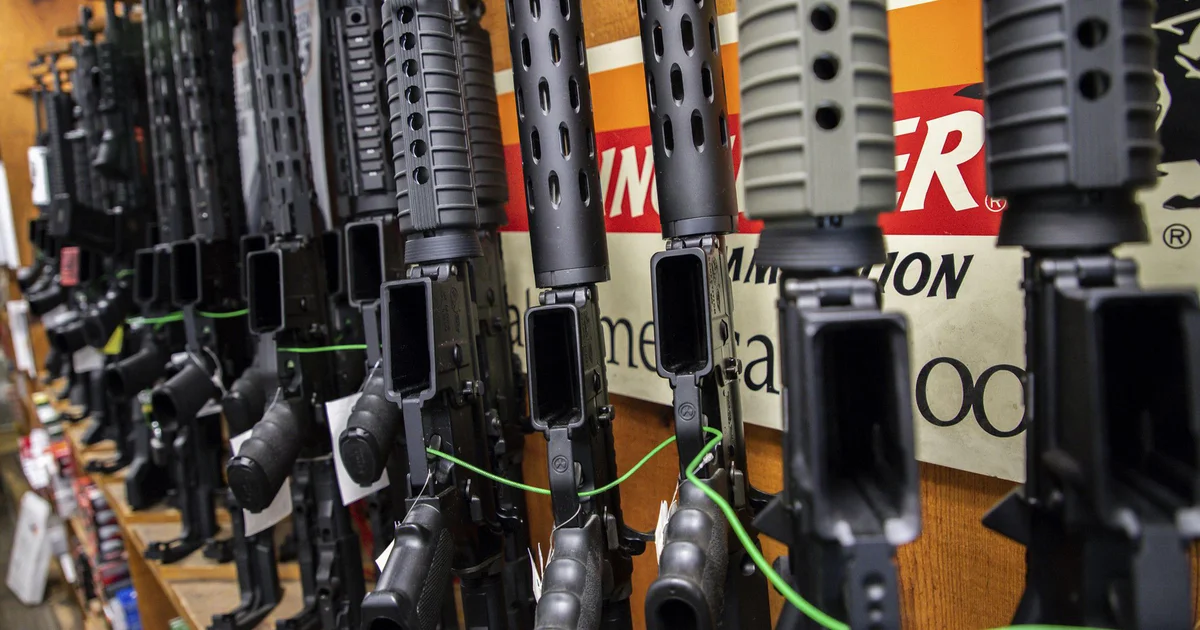
Washington — The Supreme Court on Tuesday said it will consider whether the Second Amendment guarantees the right to have AR-15-style rifles.
Read more Supreme Court says nation’s top copyright official can keep job for now
In a , the high court agreed to take up a pair of cases challenging local and state laws outlawing AR-15s and similar semi-automatic rifles. One involves an ordinance in Cook County, Illinois, and the other centers on Connecticut’s law.
The justices will hear arguments in the cases in its next term, which begins in October.
The cases are the first in which the high court will weigh the legality of laws restricting access to certain types of firearms. In a landmark 2022 decision, the Supreme Court recognized for the first time that the Second Amendment guarantees the right to carry a gun in public for self defense. But the justices had — until now — declined to take up challenges involving bans on AR-15s and similar semiautomatic rifles in Illinois and Maryland, leaving the laws in place.
Earlier this month, the Supreme Court ruled that occassional marijuana users cannot be prohibited from having firearms, and it struck down a Hawaii measure that generally barred concealed carry permit holders from bringing their guns onto private property open to the public, unless they received permission from the owner.
The Connecticut AR-15 ban
One of the cases centers on Connecticut’s laws that make it a crime to possess so-called assault weapons, including certain semiautomatic rifles like the AR-15. Connecticut first adopted an assault-weapon ban in 1993. The state tightened its restrictions after the 2012 mass shooting at Sandy Hook Elementary School in Newtown, Connecticut, when a gunman armed with an AR-15-style rifle and large-capacity magazines killed 26 children and teachers.
Residents can have a wide range of firearms, including many semiautomatic handguns, rifles and shotguns, according to the state. Fourteen states and the District of Columbia restrict access to semiautomatic weapons.
Two separate groups of plaintiffs, which include the National Association for Gun Rights and several Connecticut residents who want to own AR-15s, challenged the constitutionality of the restrictions, arguing their Second Amendment rights were violated.
Read more Supreme Court strikes down coordinated campaign spending limits
In both cases, federal district judges declined to block the bans, and the U.S. Court of Appeals for the 2nd Circuit, which considered the challenges together, affirmed that decision. The three-judge panel found that Connecticut’s ban is consistent with the country’s historical tradition of firearms regulation, applying a new test for reviewing the constitutionality of gun laws that the Supreme Court set out in 2022.
The 2nd Circuit said in its decision that AR-style rifles are “dangerous and unusual” and “particularly suited for criminal violence.” It also noted that Connecticut’s ban still allows residents to own “many popular weapons, including semiautomatic weapons deemed to be less dangerous by the legislature for self-defense and other lawful purposes.”
The gun owners appealed to the Supreme Court and argued that Connecticut’s ban on AR-15s covers “the most popular rifle in the country,” one that is owned by 10s of millions of Americans.
Cook County’s law
Cook County, which includes Chicago, enacted its ordinance banning “assault weapons” nearly 20 years ago. Under the law, it is illegal to sell, transfer or possess semiautomatic rifles, including the AR-15 and AK-47, as well as rifles that are capable of accepting magazines that hold more than 10 rounds of ammunition and have certain features. Violators of the ban are subject to up to six months in prison and a minimum $5,000 fine.
In August 2021, two Cook County residents who want to acquire banned semiautomatic rifles, as well as two gun rights groups, filed a lawsuit arguing that the assault-weapons ban violates the Second Amendment.
While their case was pending, the Supreme Court issued its landmark June 2022 decision that recognized for the first time that the right to carry firearms extends to outside the home. The high court’s ruling also set out a new framework for examining the constitutionality of gun laws, which requires the government to show that a restriction is rooted in the nation’s history and tradition of firearms regulation.
Also during that time, the state of Illinois passed its own statewide assault-weapons ban, which the U.S. Court of Appeals for the 7th Circuit upheld. As a result, a federal district court rejected the challenge to Cook County’s restriction on semiautomatic rifles. The 7th Circuit then upheld that decision.
Read more Supreme Court upholds birthright citizenship, striking down Trump’s order