
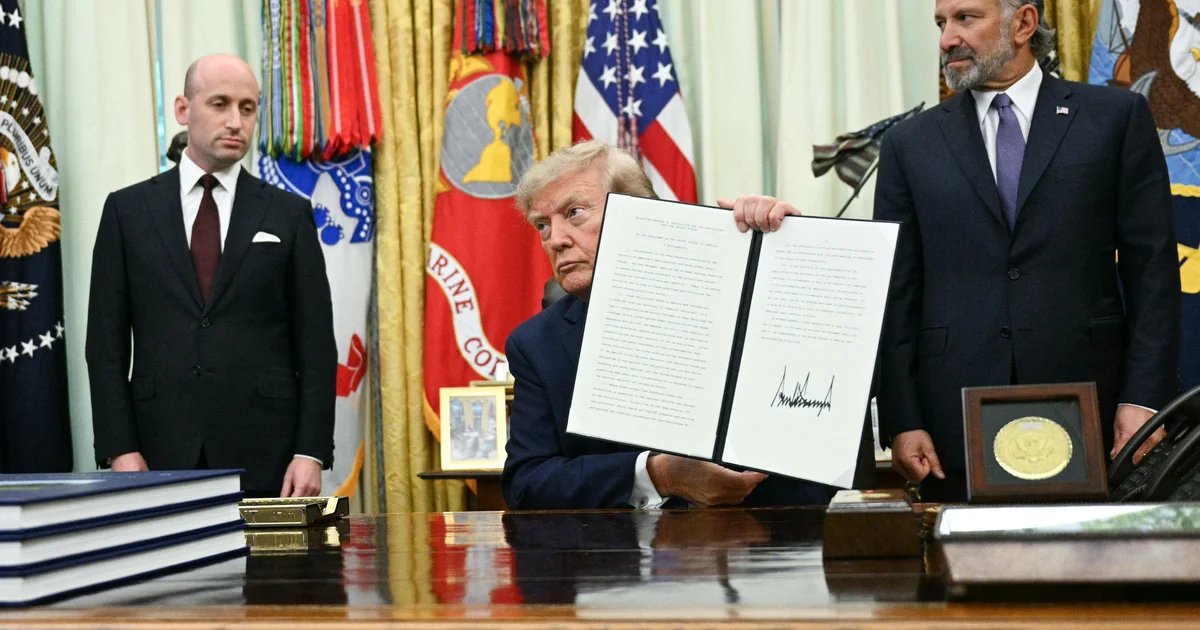
Washington — President Trump on Thursday signed two executive orders in his latest effort to refuse citizenship to some children born in the United States, after the Supreme Court struck down his earlier executive order aiming to end birthright citizenship.
Read more Sen. Marsha Blackburn wins Republican primary for Tennessee governor
“We had a very unfortunate decision in the Supreme Court concerning birthright, it was close,” Mr. Trump said in an Oval Office signing on Thursday. “But a very, very unfortunate decision. So we’re making adjustments.”
One order the president signed Thursday targets people who engage in commercial “birth tourism” by seeking to deny them access to the country. The other expands the definitions of people that it states are ineligible for birthright citizenship, such as children of foreign citizens who lobby on behalf of foreign governments.
“This has been something that people have talked about, not only for years, but for decades,” White House deputy chief of staff Stephen Miller said of “birth tourism.”
“The idea that people come here pretending to be a tourist, pretending to be a visitor, saying they want to go to Disneyland or they want to go visit a monument or go to a national park, but the real reason they’re here is to have a child, to make that child an automatic citizen, leave our country, and then have a U.S. citizen child,” Miller said. “It gives them access, under this broken system, to welfare benefits, ultimately to the voting booth, and all the other rights and privileges that belong solely to Americans.”
One of the orders lists out several categories of people who it says should not be granted citizenship documents, including the children of people who engaged “in a commercial transaction to ensure that the person’s mother is present in the United States, or a territory of the United States, to give birth.”
Also listed are children whose parents belong to terrorist groups, children of foreign government employees and children who were born in a U.S. territory “where citizenship is not conferred by Federal statute.”
The order does not apply to people with at least one parent who is a citizen.
Currently, the children of foreign diplomats already are not eligible for citizenship by birth, though Thursday’s order might expand the number of people who fall under that exception to birthright citizenship. Meanwhile, people who were born in U.S. territories like Puerto Rico are currently deemed citizens under federal law.
Axios first reported Mr. Trump would be signing the orders.
The 14th Amendment, ratified in 1868, states “all persons born or naturalized in the United States, and subject to the jurisdiction thereof, are citizens of the United States and of the state wherein they reside.”
Read more Trump-endorsed Rep. Andy Ogles projected to lose GOP primary in Tennessee
Mr. Trump has long voiced his frustration with birthright citizenship, and he and his allies have sought to make the case that the amendment was only intended to address the aftermath of slavery.
“This was done right after the Civil War,” Mr. Trump said Thursday. “This was for the babies of slaves.”
The Supreme Court ruled 6-3 that the president’s first executive order, which he issued on his first day in office in 2025, was unlawful and out of step with the 14th Amendment.
Asked if he thinks these new executive orders will pass constitutional muster, the president said, “I think it will.”
The American Civil Liberties Union condemned the executive order and predicted it would fail in court.
“The Supreme Court already decided this issue: Birthright citizenship is guaranteed by the Constitution. No additional executive order can change the meaning of the Constitution. Any executive order that tries to rewrite birthright citizenship will meet the same fate as the last one,” Cody Wofsy, deputy director of the ACLU’s Immigrants’ Rights Project, said in a statement.
“Birth tourism” came up during Supreme Court oral arguments. In regard to that issue, Chief Justice John Roberts told the U.S. solicitor general, John Sauer, “You do agree that that has no impact on the legal analysis before us.” Sauer said that such tourism is evidence of the negative effects of the prevailing interpretation of the Citizenship Clause.
“We’re in a new world now … where 8 billion people are one plane ride away from having a child who is a U.S. citizen,” Sauer said.
Read more U.S. Marine veteran, detained in Russia since 2022, is hospitalized in serious condition
“Well, it’s a new world. It’s the same Constitution,” Roberts replied.